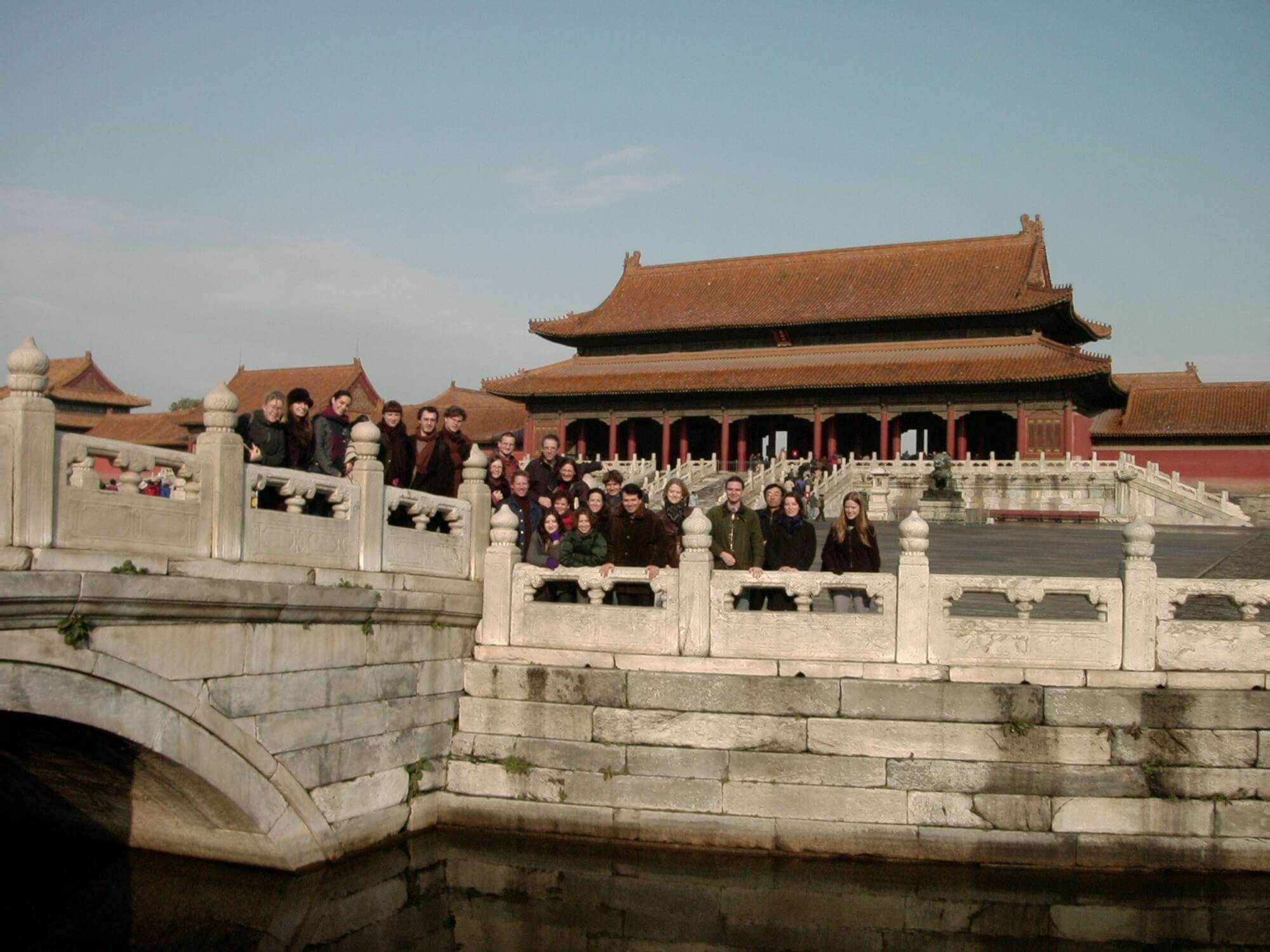
China tour
“EUBO has meant a lot to me. It has accompanied me throughout my musical life. I was a member in its very first year, then the oboe tutor, and later also its music director for a couple of tours. In 1985, EUBO still had to find its shape and identity. We spent 6 months in Oxford rehearsing a lot but playing few concerts. The directors changed every week and were the most outstanding Early Music personalities: Christie, Parrott, Kuijken, Fischer, Brüggen, Malgoire, Savall, Holloway, Pinnock, Koopman, Higginbottom and others. It was incredible to work on similar repertoires with so many different views: despite all we know from 18th-century sources, interpretation can still make music sound totally different.
After being a tutor in many EUBO auditions, I was asked in 2001 to conduct a tour to China. I had never been there, and the timing felt particularly meaningful—China had just been accepted into the World Trade Organisation, marking a moment of great transformation in its economic and cultural landscape. As far as I know, EUBO was the very first period instrument orchestra to visit China, and we had to fly in our own harpsichords from Europe, as there were no suitable instruments to rent locally. We arrived in Beijing where customs demanded a high deposit for the instruments, so Paul James and Emma Wilkinson were kept as “hostages” at the airport. It took 5 hours of negotiations, including contact with the Chinese Ministry of Culture, to solve the issue. Meanwhile, the orchestra visited the Great Wall.
We had been told that the Chinese audience was still unfamiliar with classical concerts, but at our first one didn’t encounter this and the attendees displayed great interest. For the occasion, I had arranged two popular Chinese songs as encores: the first encore sparked a joyful roar, but not the second — it turned out to be a funeral song, as the organiser later explained… The whole tour was an unforgettable adventure. EUBO has been a fulfilling experience, helping musicians understand their place in the orchestra, the importance of cooperation and collegiality, and the balance between flexibility, initiative, discipline and responsibility. I’m grateful to Paul James and Emma Wilkinson for their visionary work. Thanks to ICONS, the project lives on, offering new generations the same enriching experience and safeguarding the future of Baroque music”.
Alfredo Bernardini

